
WordPress vs Custom Website: Which Is Right for Your Business?
Choosing how to build your business website is not simply a question of WordPress vs a custom website.
It is a decision about how much control you need, how quickly you want to launch, what your website needs to do, who will manage it, and how the website may need to grow with your business.
For some businesses, WordPress provides everything they need without unnecessary development complexity. For others, a custom-built website may make more sense because the website needs to support unique functionality or business processes.
There is also a middle ground that is often overlooked: a custom-designed WordPress website.
So, which option is right for your business?
The answer depends less on which technology is considered “better” and more on what you actually need your website to accomplish.
WordPress vs Custom Website: What’s the Difference?
Before comparing the two, it is important to clarify what we mean by WordPress and custom website.
They are not always opposites.
What is WordPress?
WordPress is a content management system (CMS) that allows you to create and manage website content without building every part of the website from scratch.
A WordPress website can use:
- Pre-built themes
- Page builders
- Plugins
- Custom themes
- Custom code
- Custom functionality
This means two businesses can both have WordPress websites that are built very differently. One might use an off-the-shelf theme with several plugins, while another might use a custom designed theme and custom development.
WordPress also provides features such as customizable URLs and XML sitemaps, while its functionality can be extended through plugins and other development work.
What is a custom-built website?
A custom-built website is developed specifically for a business rather than relying primarily on an existing theme or predefined website structure.
Depending on the project, developers may build the front end, back end, database structure, integrations and functionality specifically around the business requirements.
For example, a company might need:
- A customer dashboard
- A booking system with unusual requirements
- A private client portal
- A complex internal workflow
- Custom calculations
- Multiple systems communicating with each other
In situations like these, custom development can provide greater control over how the website works.
What about a custom-designed WordPress website?
This is where the comparison becomes more interesting, You can have a custom website design built on WordPress. The design, layouts and user experience can be created specifically for the business while WordPress handles content management.
So, rather than thinking about the choice as simply: WordPress vs custom
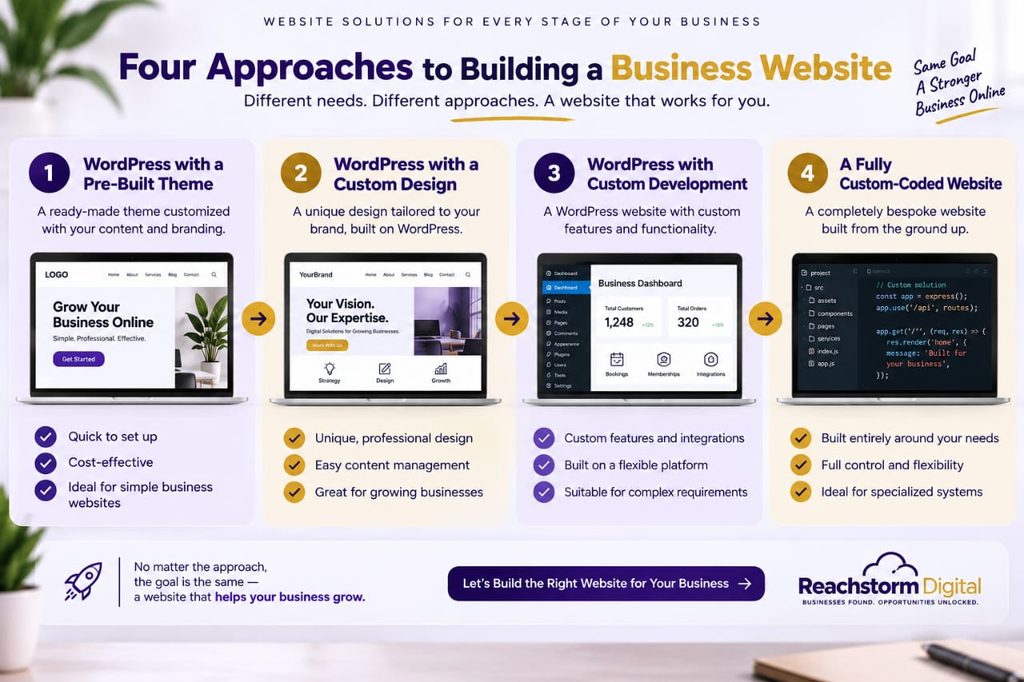
it is more useful to think about four possible approaches:
- WordPress with a pre-built theme
- WordPress with a custom design
- WordPress with custom development
- A fully custom-coded website
The right option depends on the requirements of the business.
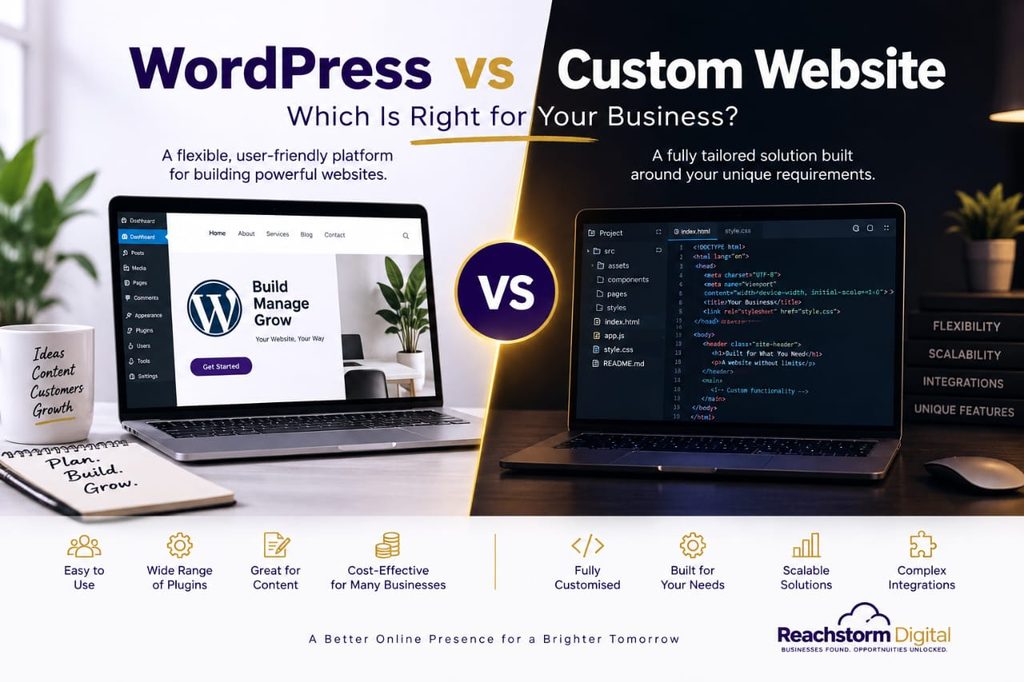
WordPress vs Custom Website at a Glance
| Factor | WordPress | Custom-Built Website |
| 1. Initial Development | Often quicker for standard websites | Usually requires more development work |
| 2. Upfront cost | Can be lower for simpler projects | Often higher depending on requirements |
| 3. Content management | Generally straightforward | Depends on the system built |
| 4. Design flexibility | High, especially with custom design/ development | Very high |
| 5. Custom functionality | Possible through plugins and develpoment | Can be built specifically around requirements |
| 6. Maintenance | Requires theme, plugin and WordPress maintenance | Requires maintenance of the custom system |
| 7. Development dependency | Can range from low to high | Usually higher |
| 8. Best suited for | Many business, content and e-commerce websites | Businesses with specialized requirements |
This table is only a starting point. The actual cost, performance and complexity of either option depend heavily on how the website is designed and developed.
Pros and Cons of WordPress
WordPress is widely used because it can support a broad range of websites without requiring every component to be developed from scratch. But that does not mean it is automatically the right choice for every business.
Advantages of WordPress
1 . It can be quicker to develop
For a typical business website, developers can work with an existing WordPress ecosystem rather than building a complete content management system from the ground up.
A service business that needs pages such as Home, About, Services, Blog and Contact may not need months of custom development.
WordPress can provide the foundation while the design and functionality are built around the business.
2. Content management is accessible
If your business regularly publishes articles, updates pages or adds new content, having a content management system can make those tasks easier. You do not necessarily need a developer to make every small content change.
That can be particularly useful for businesses investing in content marketing and SEO.
3. There is a large ecosystem
WordPress has a large ecosystem of themes, plugins and developers. This means businesses can add functionality without necessarily developing every feature from scratch.
Depending on the requirement, there are solutions for things such as forms, e-commerce, SEO, analytics, memberships and other common website functions.
4. It can be highly customizable
One common misconception is that WordPress websites must look like the themes they were built from. They don’t.
A WordPress website can be customized extensively through design, development and code. The limitation is often not WordPress itself but the way the particular website has been built.
Limitations of WordPress
1. Maintenance is still necessary
WordPress websites require ongoing maintenance.
The WordPress core, themes and plugins may need updates, and those updates need to be handled carefully.
A website that uses many third-party plugins can also become more difficult to manage over time.
2. Too many plugins can create complexity
Plugins are useful because they extend what a WordPress website can do. But installing a plugin for every small requirement can create unnecessary complexity.
Plugins may introduce compatibility issues, additional maintenance requirements or performance problems depending on how they are developed and implemented.
The goal should not be to install as many plugins as possible. It should be to use the right tools for the actual requirements of the website.
3. Complex functionality may require custom development
WordPress can handle custom development, but not every requirement should be forced into a plugin-based solution.
If your website requires a highly specialized system, trying to piece it together from multiple plugins may eventually become more complicated than building the required functionality properly.
Pros and Cons of Custom-Built Websites
A custom-built website gives developers greater control over how the website is structured and how its functionality works.
That flexibility can be valuable, but it also comes with additional responsibility.
Advantages of custom development
1. The website can be built around your requirements
Instead of adapting your business processes to an existing system, the development can be designed around the processes themselves.
This can be particularly useful when the website is more than a marketing channel and becomes part of how the business operates.
2. Greater control over functionality
A custom website can be designed to perform specific tasks that may not be available through standard website tools.
For example, a business may need a customer portal where users can log in, access personalized information and interact with other systems.
That type of requirement may justify custom development.
3. More control over the technical architecture
With a custom build, developers have greater control over the underlying architecture. This can be useful when the website has unusual technical requirements or needs to integrate deeply with other systems.
Limitations of Custom-Built Websites
1. Development can be more complex
A custom website generally requires more development work because more components may need to be designed and built specifically for the project. That can increase the time required to launch.
2. The initial investment can be higher
Custom development involves more specialized work. The cost therefore depends heavily on what is being built, the technology involved, integrations, functionality and the development team.
A simple custom website and a complex business platform are obviously very different projects.
3. You may depend more heavily on developers
If your website relies on custom code, changes and maintenance may require someone with knowledge of that codebase. That is not necessarily a problem, but it should be considered before choosing the approach.
4. You are responsible for more of the system
With greater control comes greater responsibility. Security, updates, backups, performance, integrations and maintenance still need to be managed. Custom does not mean maintenance-free.
WordPress vs Custom Website for SEO
One of the most common questions businesses ask is whether a custom website is better for SEO than WordPress. There is no automatic winner.
Google’s guidance focuses on how well a website can be crawled, understood and experienced by users rather than simply whether it was built with WordPress or custom code. Technical factors such as site structure, page experience, mobile usability, links and content all matter.
A well-built WordPress website can perform well in search.
A poorly built WordPress website can perform badly.
The same is true of custom development.
For SEO, pay attention to things such as:
- Crawlability
- Site architecture
- Page speed and Core Web Vitals
- Mobile usability
- Internal linking
- Page titles and descriptions
- Structured data where appropriate
- Image optimization
- Useful, relevant content
- Clean and logical URLs
- Proper redirects when pages move
- Technical errors that prevent search engines from accessing important content
The technology underneath the website is only part of the equation.
A custom-coded website does not automatically rank better simply because it is custom-coded.
Likewise, using WordPress does not automatically give a website an SEO advantage.
What matters is how the website is built, maintained and optimized.
Which Is More Expensive: WordPress vs Custom?
There is no single price difference that applies to every business.
The better question is:
What will this website cost to build, operate and maintain over time?
For WordPress, costs can include:
- Domain registration
- Hosting
- Premium themes
- Premium plugins
- Custom design
- Custom development
- Security and maintenance
- Professional support
- SEO and content
- E-commerce functionality where required
For custom development, costs can include:
- UI/UX design
- Front-end development
- Back-end development
- Database development
- Integrations
- Hosting
- Security
- Maintenance
- Developer support
- Future improvements
A simple WordPress website may therefore cost considerably less than a complex custom system.
But a heavily customized WordPress website with many integrations and bespoke functionality may require significant development work.
Don’t forget hosting
Hosting is one of the ongoing costs to consider when building a website. If you’re launching a WordPress website, the hosting provider you choose can affect your ongoing expenses and the resources available to your website.
If you’re looking for a hosting provider for your website, you can explore Namecheap’s hosting options.
Affiliate disclosure: This article contains affiliate links. If you purchase through a link, Reachstorm Digital may earn a commission at no additional cost to you.
.
Which One Is Faster to Build WordPress vs Custom Website?
For a straightforward business website, WordPress can often provide a faster starting point because much of the underlying infrastructure already exists.
You do not necessarily need to build a content management system, user interface framework or common website functionality from scratch.
A custom website may take longer when the project requires unique functionality, custom architecture or complex integrations.
However, development time is determined by the project not just the technology. A poorly planned WordPress project can take longer than expected.
A well-defined custom project can sometimes be delivered efficiently.
The important question is:
How much does your website actually need to be built from scratch?
WordPress vs Custom Website: Which Is Easier to Maintain?
This depends on what has been built.
A relatively straightforward WordPress website can be easy for a business owner or marketing team to manage.
You can log in, publish content, update pages and manage many common website tasks without modifying the underlying code.
However, WordPress maintenance still matters. Updates, backups, security and plugin compatibility should not be ignored.
A custom website may require more technical involvement because the business may depend on developers to maintain or modify the system.
But custom development can also eliminate some of the complexity associated with managing a large collection of third-party plugins.
So rather than asking:
Which is easier to maintain?
Ask:
Who will maintain this website, and what will they need to maintain?
That gives you a much more useful answer.
When Does WordPress Make Sense?
WordPress can be a practical choice when your website primarily needs to provide information, attract potential customers, publish content or support relatively standard business functions.
It may make sense for:
1. Small and growing businesses
If you need a professional website to explain what you offer, generate enquiries and build your online presence, you may not need a custom system.
2. Service businesses
Consultants, agencies, professional services, local businesses and other service providers can often build what they need with WordPress.
3. Content-focused businesses
If publishing articles, guides, resources or other content is an important part of your marketing, WordPress provides a content management environment designed around publishing.
4. Businesses that want to manage their own content
If you want your team to update pages and publish content without contacting a developer every time, WordPress can be useful.
5. Businesses with standard e-commerce requirements
WordPress can also support online stores through e-commerce solutions when the business requirements fit what those platforms provide. The important point is not that WordPress is suitable for everyone.
It is that many businesses do not need to build everything from scratch.
When Does a Custom Website Make Sense?
Custom development becomes more relevant when your website needs to do something that standard website tools cannot handle efficiently.
For example:
Complex booking systems
A business with unusual booking rules, availability requirements or scheduling processes may need custom functionality.
Customer portals
If customers need personalized dashboards, accounts or access to private information, custom development may be appropriate depending on the requirements.
Complex integrations
A business may need its website to communicate with internal systems, external platforms, databases or other software.
Specialized workflows
If the website needs to support a unique business process, building the functionality specifically around that process can make sense.
The website is effectively part of the product
This is an important distinction. If your website is simply a marketing tool, you may not need the complexity of a fully custom platform. But if customers use the website to perform important tasks that are central to your business, the technical requirements may be very different.
Can You Start With WordPress and Go Custom Later?
Yes, but it requires planning.
A business does not necessarily have to make an irreversible decision between WordPress and custom development on day one.
You could start with WordPress while your requirements are relatively straightforward and consider a different architecture later if the business develops more complex needs.
However, moving a website is not simply a matter of rebuilding the pages.
You may need to consider:
- Existing URLs
- Search engine rankings
- Redirects
- Website content
- Images and media
- Customer data
- Forms
- Integrations
- Analytics
- SEO metadata
- Internal links
- Structured data
- Functionality
If a redesign or migration changes URLs, proper redirects and technical planning become especially important.
The goal is to improve the website without unnecessarily losing the value you’ve already built
7 Questions to Ask Before Choosing
Before deciding between WordPress and custom development, ask these questions.
1. What does the website actually need to do?
Start with functionality, not technology.
Write down what customers need to be able to do on the website.
2. Who will update the website?
Is your content going to be managed internally?
Will a marketing team publish articles?
Will a developer handle everything?
Your answer affects which setup makes practical sense.
3. How much customization do you actually need?
Do you need a unique website experience, or do you mainly need a professional website that communicates your services and generates enquiries?
There is a significant difference.
4. What integrations are required?
List the tools and systems the website needs to connect with before choosing your platform.
5. How quickly do you need to launch?
If you need a standard business website relatively quickly, building every component from scratch may introduce unnecessary development time.
6. Who will handle maintenance?
Consider this before launch, not after something breaks.
7. What might the website need to do in two or three years?
Your current requirements matter, but so does your likely direction.
You don’t need to build a complex system today just because you might need one someday.
At the same time, you should avoid choosing a setup that makes an obvious future requirement unnecessarily difficult.
WordPress vs Custom Website: Which Should You Choose?
There is no single answer that applies to every business.
WordPress may be suitable if:
- You need a professional business website
- Your website has relatively standard functionality
- You want to publish and manage content easily
- You want to launch without building everything from scratch
- Your business does not require a highly specialized system
Custom development may be suitable if:
- Your website requires specialized functionality
- You need complex integrations
- Customers need sophisticated dashboards or portals
- Your website supports unique business workflows
- The website is becoming an important part of the product or service itself
A custom-designed WordPress website may be the middle ground
You don’t necessarily have to choose between a generic WordPress theme and a completely custom-coded platform.
A business can use WordPress as the content management system while having the website’s design and functionality customized around its requirements.
For many businesses, that distinction is more useful than the simple question of WordPress vs custom website. The goal isn’t to choose the technology that sounds more advanced.
The goal is to choose an approach that gives your business what it actually needs without creating unnecessary complexity.
Frequently Asked Questions
Is WordPress better than a custom website?
Neither is automatically better.
WordPress can be suitable for businesses that need a flexible content management system and relatively standard website functionality. Custom development may make more sense when the website requires specialized functionality, complex integrations or unique workflows.
Is a custom website better for SEO?
Not automatically.
SEO depends on factors such as technical implementation, website architecture, content, crawlability, mobile usability, performance, internal linking and other search-related signals.
A well-built WordPress website can perform well in search, just as a well-built custom website can.
Is WordPress outdated in 2026?
No. WordPress remains an actively developed content management system and continues to be used for websites ranging from small business sites to much larger publishing and commercial websites.
The more useful question is whether WordPress is appropriate for your particular requirements.
Is WordPress cheaper than a custom website?
It can be for simpler projects, but there is no universal price difference. Your total cost depends on design, development, hosting, plugins, integrations, maintenance, content and future changes.
Can a WordPress website be fully customized?
Yes.
WordPress websites can use custom designs, custom themes and custom development. The fact that a website uses WordPress does not mean it has to look or function like a pre-built template.
When does a business need a custom website?
A business may need custom development when its website requires specialized functionality, complex integrations, unique workflows, sophisticated user accounts or other requirements that standard website solutions cannot handle efficiently.
Final Thought
Choosing between WordPress and custom development should not begin with:
Which technology is better?
Start with:
What does my business actually need this website to do?
If your requirements are straightforward, a well-built WordPress website may give you the flexibility you need without unnecessary development complexity.
If your website needs to support specialized processes, complex integrations or functionality that standard solutions cannot handle well, custom development may be worth considering.
And if you need a more distinctive design without giving up the flexibility of a content management system, a custom-designed WordPress website can be another option.
The best decision is the one that matches your requirements, resources and long-term plans—not the one based on which technology sounds more impressive.
Need help deciding?
Not sure what your business actually needs from its website?
Reachstorm Digital can help you evaluate your website requirements before you invest in the build.
Talk to Reachstorm Digital