
SEO for Beginners: A Practical Guide to Getting Your Website Found
SEO for beginners can feel complicated at first, especially when you’re faced with different Terminologies such as keywords, backlinks, technical SEO, search intent, etc. The good news is that SEO doesn’t have to be complicated.
If you have a website but struggle to get people to find it through Google, you’re not alone.
At its core, Search Engine Optimization (SEO) is about helping search engines understand your website and helping the right people discover your content, products, or services when they search online.
But effective SEO goes beyond adding keywords to a webpage.
It involves understanding what your audience is searching for, creating genuinely useful content, making your website easy for search engines to access and understand, and continuously improving based on what the data tells you.
In this beginner’s guide, we’ll break SEO down into practical steps so you can understand what SEO is, how it works, where to start, and what actually matters when trying to improve your website’s visibility.
What Is SEO?
SEO stands for Search Engine Optimization.
It is the process of improving your website and its content so that search engines can better understand it and potentially show your pages to people searching for relevant information, products, or services.
For example, imagine you run a website offering accounting services.
Someone searches Google for:
“accounting services for small businesses”
If your website has a well-optimized page that clearly explains your service and satisfies what that searcher needs, your page may have an opportunity to appear in the organic search results.
That’s the fundamental idea behind SEO:
Someone searches → your website provides a relevant answer or solution → search engines can understand it → the right page has an opportunity to be discovered.
SEO can help businesses:
Increase organic visibility
Attract relevant website visitors
Build credibility
Generate leads and enquiries
Increase opportunities for sales
Build a long-term source of website traffic
However, SEO isn’t a magic formula for guaranteeing the number-one position. Search engines consider many factors when deciding which pages to show for a particular search. That’s why good SEO starts with understanding the searcher, not simply trying to manipulate rankings.
How Does SEO Work?
How Does SEO Work?
Before learning SEO techniques, it’s useful to understand what happens when someone searches for something online.
A simplified version looks like this:
Crawling → Indexing → Understanding → Ranking → Search Results
1. Crawling
Search engines use automated systems, often called crawlers or bots, to discover webpages.
They can discover pages through links, sitemaps, previously known URLs, and other sources.
2. Indexing
Once a search engine discovers a page, it can analyze and store information about that page in its index.
Being indexed doesn’t mean your page will automatically rank highly.
It simply means the search engine has potentially included the page in the collection of pages it can consider for searches.
3. Understanding
Search engines need to understand what your page is about.
They can analyze things such as:
Page content
Titles
Headings
Links
Images
Context
Website structure
This is one reason clear, useful content matters.
4. Ranking
When someone performs a search, the search engine evaluates relevant pages and determines which results are most appropriate for that particular query.
The exact systems involved are complex and constantly evolving.
5. Showing the Results
The search engine then presents results to the user.
Depending on the query, this may include traditional organic results, images, videos, local results, and other search features.
The goal of SEO is therefore not simply to “put keywords on a website.”
Google provides its own SEO Starter Guide for website owners who want to understand the fundamentals of making their content easier for search engines to crawl, index, and understand.
Where Should a Beginner Start With SEO
If you’re completely new to SEO, it’s easy to feel overwhelmed by the number of things you’re supposed to optimize.
You might hear about keywords, backlinks, technical SEO, content clusters, schema markup, Core Web Vitals, and dozens of SEO tools.
Don’t try to do everything at once.
A better approach is to build your SEO foundation in the right order.
1. Understand Your Audience
Before researching keywords, understand who you’re trying to reach.
Ask:
Who are my ideal customers?
What problems are they trying to solve?
What questions do they ask?
What products or services are they looking for?
What information would help them make a decision?
SEO becomes much more effective when you understand the person behind the search.
2. Research What Your Audience Searches For
Once you understand your audience, identify the words, phrases, and questions they use when searching.
This is where keyword research comes in.
For example, someone interested in SEO might search:
“What is SEO?”
“SEO for beginners”
“SEO tips for beginners”
“How does SEO work?”
“How to start SEO”
“Best SEO tools”
These searches can reveal what people want to learn and the topics your website could potentially address.
3. Understand Search Intent
Finding a keyword isn’t enough.
You also need to understand why someone is searching for it.
Someone searching for “what is SEO” is probably looking for an explanation.
Someone searching for “SEO agency” may be investigating service providers.
Someone searching for “SEO services” may be much closer to making a purchasing decision.
The content you create should match that intent.
4. Create Content That Actually Helps
Once you understand the topic and search intent, create something genuinely useful.
Don’t write an article simply because a keyword has search volume.
Ask:
“If someone finds this page through Google, will it actually help them?”
Useful content should answer questions clearly, solve problems, provide practical guidance, or help the reader make a better decision.
5. Optimize Your Website
Your content is only part of SEO.
You should also make sure your website is structured properly and that important pages are easy for both users and search engines to access.
This includes things such as:
Clear page titles
Logical headings
Useful meta descriptions
Descriptive URLs
Optimized images
Internal links
Mobile-friendly design
Fast and usable pages
6. Measure and Improve
SEO isn’t a one-time task.
After publishing and optimizing your pages, monitor what happens.
Look at:
Which searches are bringing impressions
Which pages receive organic traffic
Which keywords are gaining visibility
Which pages aren’t performing
Whether organic visitors are becoming leads or customers
Then use what you learn to improve your strategy.
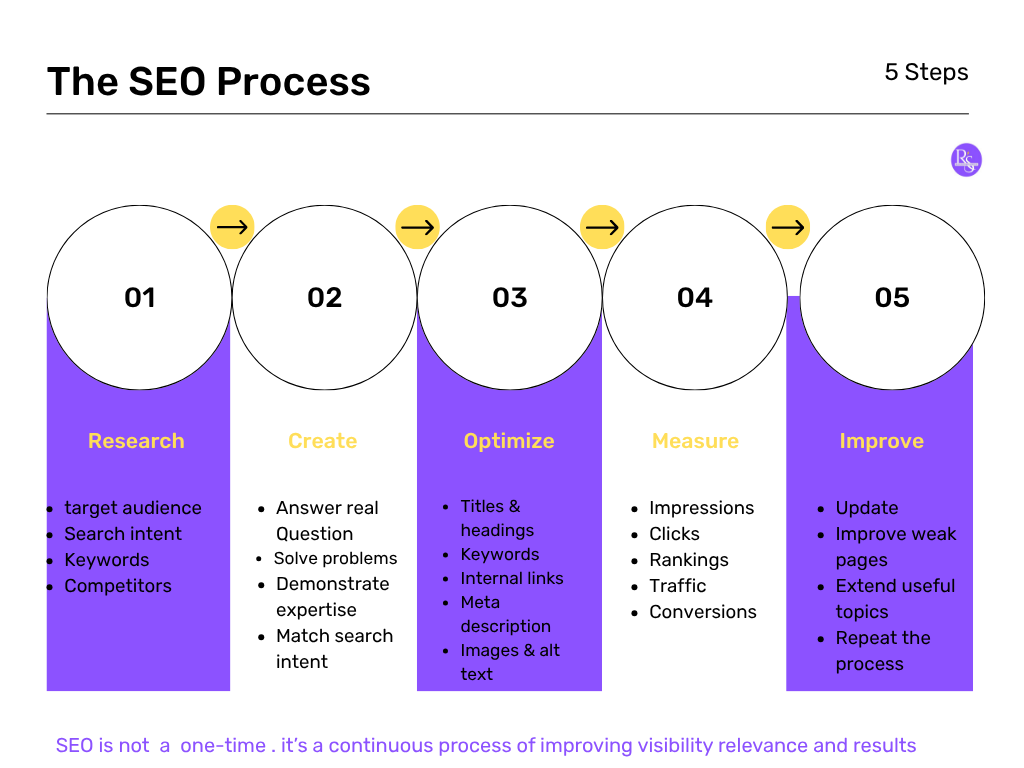
A simple SEO process is:
Understand → Research → Create → Optimize → Measure → Improve → Repeat
That’s a much better starting point than trying to learn every advanced SEO technique immediately.
How to Find the Most Relevant Keywords
Keyword research is one of the foundations of SEO, but beginners often make the mistake of choosing keywords based only on search volume.
A keyword with thousands of searches isn’t necessarily a better opportunity than one with a few hundred searches.
The real question is:
Does this keyword represent something my audience actually needs, and can my website provide the best answer or solution?
Start With Your Main Topic
Begin with a broad topic related to your business.
For example, if you provide SEO services, your starting topic might be:
SEO
From there, keyword research can reveal related searches such as:
SEO for beginners
SEO tips
SEO tools
SEO for websites
How does SEO work?
What is SEO?
How to improve SEO
These related searches help you understand how people think about the topic.
Look Beyond Search Volume
Keyword research tools may show you metrics such as:
Search volume
- Keyword difficulty
- Competition
- Trends
- Related keywords
- Questions
These numbers are useful, but they shouldn’t make the decision for you.
Consider relevance, search intent, competition, and business value alongside volume.
For example, a keyword with 500 highly relevant monthly searches could potentially be more valuable to a business than a keyword with 20,000 searches from people who aren’t its target audience.
Pay Attention to Long-Tail Keywords
Long-tail keywords are more specific search phrases, often containing several words.
For example:
“SEO”
is broad.
While:
“How to improve SEO for a small business website”
is much more specific.
Specific searches can reveal a clearer problem or intention, making them useful for creating focused content.
Use Questions as Content Opportunities
Questions can be particularly valuable because they reveal exactly what people want to know.
Tools such as AnswerThePublic can help uncover questions and phrases people associate with a topic.
For example:
What is SEO?
How does SEO work?
Can I do SEO myself?
How do I find relevant keywords?
How do I track SEO performance?
Instead of treating these questions simply as keywords, use them to understand the information your audience expects to find.
Don’t Choose Keywords You Cannot Satisfy
Before targeting a keyword, ask yourself:
Can my website realistically provide a useful answer to this search?
If the answer is no, move on.
The strongest keyword strategy isn’t about collecting the largest possible list of keywords.
It’s about finding relevant opportunities where your expertise, content, products, or services can genuinely satisfy the searcher’s need.
Keyword research should tell you what people are looking for. Search intent should tell you what you need to give them.
Understanding Search Intent: An Essential SEO Skill for Beginners
Finding the right keyword is only half of the SEO process.
You also need to understand why the person is searching for that keyword.
This is known as search intent.
If your content doesn’t match the searcher’s intent, even excellent writing may struggle to perform well because it isn’t giving the visitor what they came looking for.
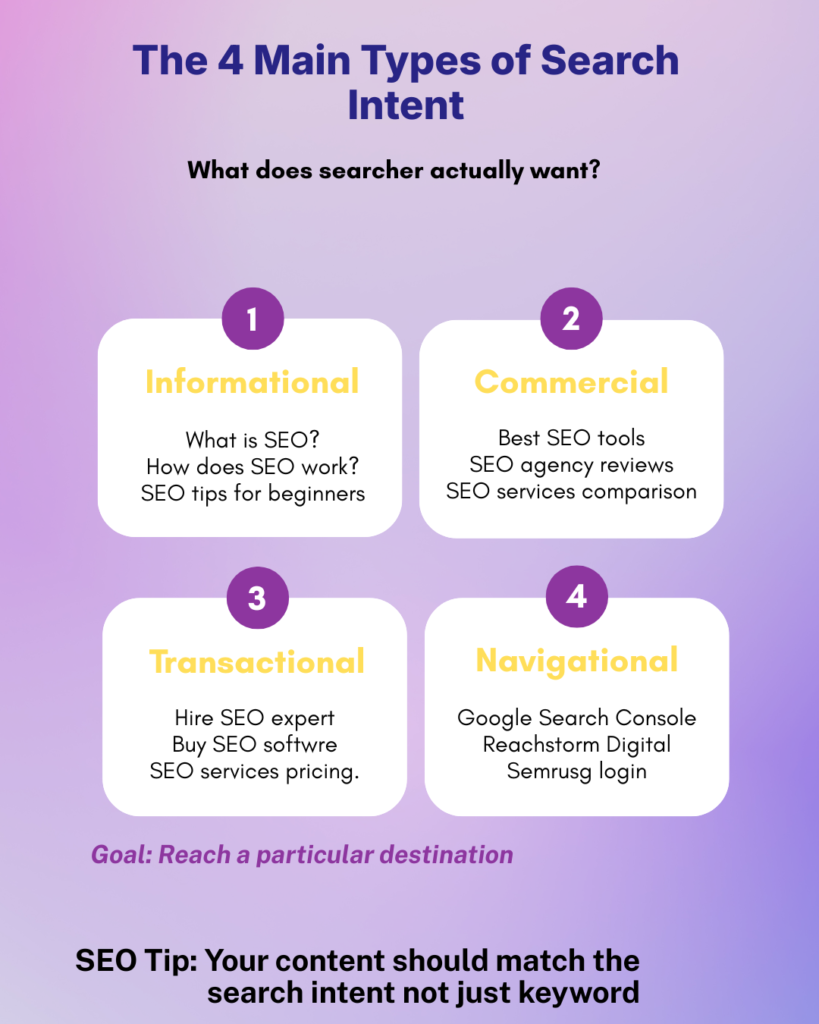
Informational Intent
The searcher wants to learn something or find an answer.
Examples include:
“What is SEO?”
“How does SEO work?”
“SEO tips for beginners”
“How to find relevant keywords”
For these searches, a detailed guide, tutorial, explanation, or educational article may be appropriate.
Navigational Intent
The searcher is trying to find a particular website, brand, or page.
For example:
“Semrush”
“Google Search Console”
“Reachstorm Digital”
The person already has a destination in mind.
Commercial Investigation
The searcher is researching options before making a decision.
Examples include:
“Best SEO tools”
“Top SEO audit services for ecommerce”
“Best SEO agency”
“SEO tools for small business”
These searches often require comparison guides, reviews, case studies, service pages, or other decision-support content.
Transactional Intent
The searcher is ready to take an action.
Examples might include:
“SEO services”
“Hire SEO agency”
“SEO consultant near me”
Here, a well-structured service or landing page may be more appropriate than a long educational article.
How to Identify Search Intent
One of the simplest ways to understand search intent is to search the keyword yourself.
Look at the pages appearing in the results.
Ask:
- Are they mainly guides?
- Are they service pages?
- Are they product pages?
- Are they comparison articles?
- Are they videos?
- Are they local business listings?
The search results provide valuable clues about what search engines believe users are looking for.
Your goal isn’t to copy those pages.
Instead, understand what need they are satisfying and how you can create something more useful, clearer, more complete, or more relevant.
Don’t create content simply because people search for a keyword. Create content because you understand what those people are trying to accomplish.
How to Create SEO Content That Search Engines and People Value
Once you understand your keywords and the intent behind them, the next step is creating the actual content.
This is where many SEO strategies go wrong.
Some websites focus so heavily on keywords that the content becomes repetitive, unnatural, or written primarily for search engines rather than people.
Good SEO content starts with a different question:
What would make this page genuinely useful to someone who found it through search?
Answer the Searcher’s Question Clearly
Don’t make visitors search through several paragraphs to find a simple answer.
Give them the answer early, then provide the explanation, examples, and details they need.
For example, if the page targets “what is SEO?”, the reader should understand what SEO means within the opening section.
Go Beyond What Everyone Else Is Saying
Researching competing pages is useful, but copying them isn’t a content strategy.
Look at what the strongest pages cover and ask:
What questions do they answer?
What important questions are missing?
Are their explanations too technical?
Could the information be organized better?
Are there practical examples missing?
What could make the experience easier for a beginner?
This is where content gaps can become opportunities.
Your goal should be to create something that adds value—not simply another version of what already exists.
Make Your Content Easy to Read
Even excellent information can lose its value if it’s difficult to consume.
Use:
Short paragraphs
Descriptive headings
Bullet points
Numbered steps
Examples
Clear explanations
Appropriate images or visuals
Avoid unnecessary jargon, particularly when writing for beginners.
If you must use a technical term, explain it in plain language.
Don’t Write for a Word Count
A common misconception is that longer articles automatically rank better.
They don’t.
A 3,000-word article that answers a question clearly can be more useful than a 10,000-word article filled with repetition.
The goal is not to reach a particular number of words.
The goal is to provide enough useful information to satisfy the searcher’s need.
Keep Content Fresh
SEO doesn’t end when you click Publish.
As information changes, competitors improve, and your own understanding grows, older content may need updating.
Review important articles periodically and ask:
- Is the information still accurate?
- Are there newer examples?
- Are any links broken?
- Has search intent changed?
- Can the article answer the question better today?
This turns content creation into an ongoing improvement process rather than a one-time activity.
The best SEO content isn’t the content that says the most. It’s the content that helps the right reader accomplish what they came to search for.
On-Page SEO: Optimizing the Pages on Your Website
Creating valuable content is important, but you also need to help search engines understand what each page is about.
This is where on-page SEO comes in.
On-page SEO refers to improvements you make directly to your webpages and their content to improve relevance, clarity, usability, and search visibility.
Optimize Your Page Title
The page title tells users and search engines what the page is about.
A good title should be:
- Clear
- Relevant to the page
- Specific
- Appealing to the intended audience
For example:
SEO for Beginners: A Practical Guide to Getting Your Website Found
is much clearer than:
Everything You Need to Know About Online Marketing
The title should accurately represent what the visitor will find on the page.
Use Clear Headings
Headings organize your content and make it easier to scan.
Use your main heading for the page’s primary topic, then organize supporting sections with appropriate subheadings.
For example:
H1: SEO for Beginners
H2: How Does SEO Work?
H3: Crawling
H3: Indexing
This creates a logical structure for both readers and search engines.
Write Useful Meta Descriptions
A meta description is a short summary that can appear beneath your page title in search results.
It should give potential visitors a clear idea of what they’ll find on the page.
Don’t simply fill it with keywords.
Instead, write a concise and compelling description that accurately represents the page.
Create Descriptive URLs
Your page URL should make sense to humans.
For example:
example.com/seo-for-beginners/
is easier to understand than:
example.com/page?id=4729
Keep URLs simple, descriptive, and relevant to the page.
Optimize Your Images
Images can improve the experience of your content, but they also need to be handled properly.
Consider:
- Using descriptive image filenames
- Adding appropriate alt text
- Compressing large images
- Using suitable image dimensions
- Making sure images display properly on mobile devices
Alt text is particularly important for accessibility because it helps describe an image to people who cannot see it.
Use Internal Links
Internal links connect one page on your website to another.
For example, this article could naturally link to a future Reachstorm Digital article about keyword research, allowing readers to explore the subject in greater depth.
Internal linking can help visitors discover related content while also helping search engines understand the relationships between pages on your website.
Don’t Forget the User Experience
SEO isn’t just about what search engines can understand.
Your visitors matter too.
Make sure your website is:
- Easy to navigate
- Mobile-friendly
- Easy to read
- Secure
- Accessible
- Free from unnecessary distractions
A page that ranks well but provides a frustrating experience isn’t achieving the full purpose of SEO.
On-page SEO isn’t about adding as many optimization elements as possible. It’s about making each page clear, useful, accessible, and easy to understand
Technical SEO: Making Your Website Easy to Crawl and Use
On-page SEO focuses mainly on the content and individual pages of your website.
Technical SEO focuses on the underlying website structure and technical factors that can affect how search engines access, understand, and process your site.
You don’t need to be a developer to understand the basics.
Make Your Important Pages Accessible
Search engines need to be able to discover and access the pages you want to appear in search results.
Check that important pages aren’t accidentally blocked or hidden from search engines.
Your website should also have a logical structure that makes it easy to move from one section to another.
Create and Maintain an XML Sitemap
An XML sitemap provides search engines with information about the URLs you consider important on your website.
For many websites, SEO plugins or content management systems can help generate and maintain a sitemap.
However, having a sitemap doesn’t guarantee that every URL will be indexed or rank.
Make Your Website Mobile-Friendly
A large portion of online searches happen on mobile devices.
Your website should therefore work properly across different screen sizes.
Check that:
- Text is readable
- Buttons are easy to tap
- Menus work properly
- Images don’t overflow the screen
- Forms are usable
- Important content isn’t hidden
Don’t assume your desktop version automatically provides a good mobile experience.Improve Website Speed
People don’t want to wait for a page that takes too long to load.
Large images, unnecessary scripts, poor hosting configurations, and excessive plugins can contribute to performance problems.
You don’t need to chase a perfect speed score simply for the sake of a number.
Instead, focus on creating a fast, stable, and usable experience for your visitors.
Use HTTPS
HTTPS encrypts the connection between a visitor’s browser and your website.
You should ensure your website uses HTTPS and that visitors aren’t being unnecessarily redirected between insecure and secure versions.
Fix Broken Links and Important Errors
Broken links can create frustrating experiences for visitors and make it harder to navigate your website.
Regularly check important pages and links, particularly after:
- Changing URLs
- Deleting pages
- Redesigning your website
- Migrating to a new platform
When appropriate, redirect old URLs to relevant new pages rather than leaving visitors at dead ends.
Check Your Indexing
One of the most important technical SEO questions is:
Are the pages I want people to find actually available for search engines to index?
Tools such as Google Search Console can help you identify indexing and search visibility issues.
For beginners, this is one of the best places to start before worrying about advanced technical SEO.
Technical SEO isn’t about making your website complicated. It’s about removing technical obstacles so search engines and visitors can access and use your important pages.
Backlinks and Off-Page SEO: Building Your Website’s Authority
Not everything that influences your website’s visibility happens on your own website.
Off-page SEO refers to activities and signals that take place outside your website and can contribute to how your website is perceived in the wider web.
One of the most discussed areas of off-page SEO is backlinks.
What Are SEO Backlinks?
A backlink is a link from another website to a page on your website.
For example, if an industry publication writes an article about digital marketing and links to a useful guide on your website, that link is a backlink.
Backlinks can help search engines discover pages and can contribute to signals of authority and relevance.
But not all backlinks are equally valuable.
Quality Matters More Than Quantity
A common beginner mistake is thinking:
“The more backlinks I get, the higher I’ll rank.”
SEO doesn’t work that simply.
A relevant, trustworthy link can be much more valuable than hundreds of irrelevant or low-quality links.
For example, a relevant link from a respected publication in your industry is generally more meaningful than dozens of links from unrelated websites created solely to manipulate rankings.
How Can You Earn Backlinks?
Instead of trying to collect links, focus on creating things that other people have a genuine reason to reference.
You could create:
- Original research
- Useful statistics
- Comprehensive guides
- Case studies
- Templates
- Checklists
- Free tools
- Expert resources
- Unique insights
You can also build legitimate relationships with businesses, publications, and professionals within your industry.
The goal is earning relevant attention, not manufacturing links.
Avoid Manipulative Link Building
Be careful with services promising thousands of backlinks for a very small fee.
Large numbers of low-quality links don’t automatically create authority and can potentially create problems for your website.
A sustainable approach is to ask:
“What can we publish that another reputable website would genuinely want to reference?”
That’s a much stronger question than:
“How can I get 1,000 backlinks?”
Off-Page SEO Goes Beyond Backlinks
Backlinks are important, but your website’s broader online presence can matter too.
Depending on your business, this can include:
- Brand mentions
- Digital PR
- Industry relationships
- Reviews
- Relevant citations
- Genuine community participation
- Content distribution
The objective is to build real credibility and recognition around your brand.
Don’t build links simply to manipulate rankings. Build a brand and resources worth linking to.
Local SEO: Helping Customers Find Your Business
If your business serves customers in a specific location, local SEO can help you become more visible when people search for products or services in that area.
For example:
“SEO agency in Lagos”
“digital marketing agency near me”
“law firm in London”
“medical laboratory near me”
However, local SEO isn’t relevant only to businesses that operate from physical stores. Service-area businesses can also benefit when they serve customers within particular locations.
Create and Optimize Your Google Business Profile
For eligible local businesses, a Google Business Profile is an important part of local visibility.
Make sure your business information is accurate and consistent, including:
- Business name
- Category
- Contact information
- Opening hours
- Website
- Business location or service area
Keep the profile updated as your business changes.
Keep Your Business Information Consistent
Your business name, contact details, website, and other important information should be accurate wherever your business appears online.
Inconsistent information can create confusion for both potential customers and search engines.
Encourage Genuine Customer Reviews
Reviews can influence how potential customers perceive your business.
Encourage satisfied customers to leave honest reviews based on their actual experience.
Don’t manufacture reviews or pressure customers into posting misleading feedback.
Create Useful Local Content
If location is important to your customers, create content that genuinely addresses local needs.
For example, a marketing agency serving businesses in a particular city could publish:
“A Small Business Guide to Digital Marketing in [Location]”
But don’t add locations to pages simply to manipulate rankings.
The location should be genuinely relevant to the content and the business.
Don’t Confuse Local SEO With Your Entire SEO Strategy
This is especially important for businesses that operate online.
If your company can serve customers across different countries or regions, you shouldn’t limit your entire SEO strategy to one city or country simply because local SEO exists.
Instead, your SEO strategy should reflect where your actual customers are and where your business can realistically provide its products or services.
Local SEO is one part of SEO, not the whole strategy.
Good local SEO helps the right customers discover your business in the places you actually serve.

How to Track Your SEO Performance
SEO should not be based on guesswork. Once you begin optimizing your website and publishing content, you need to monitor what is happening and use that information to improve your strategy.
Monitor Your Search Visibility
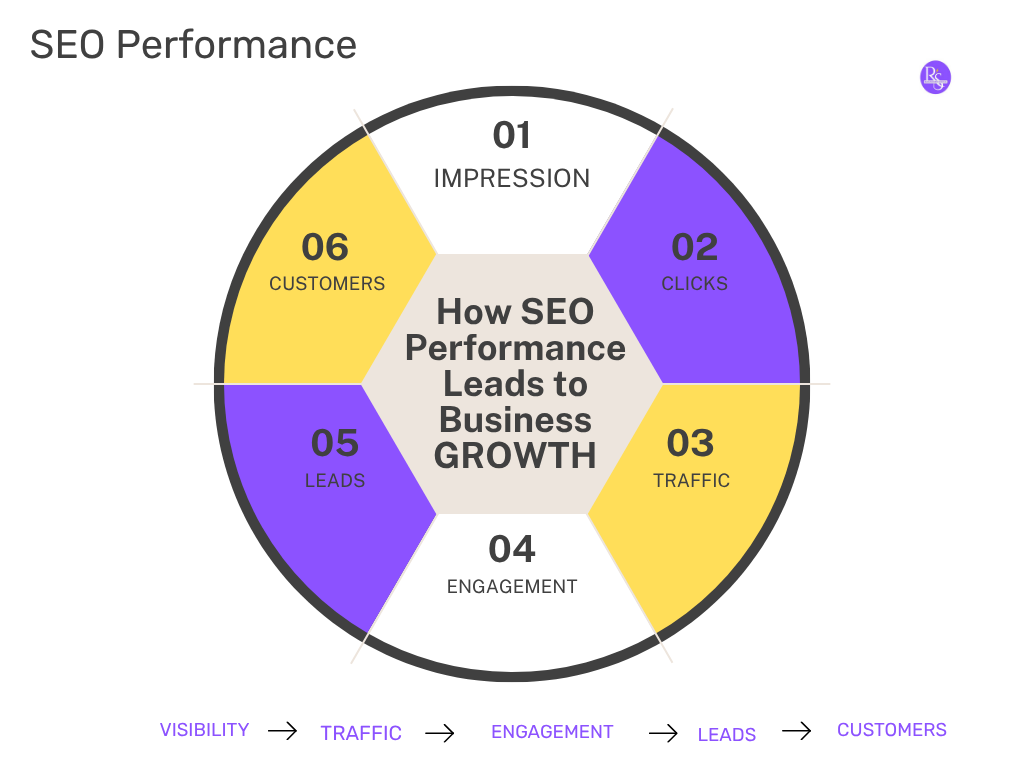
Tools such as Google Search Console can help you see:
- How often your pages appear in search results
- Which search queries are generating impressions
- How many people click your pages
- Which pages are receiving search traffic
- How your visibility changes over time
These insights can reveal opportunities you might otherwise miss.
Look Beyond Rankings
Ranking positions are useful, but they shouldn’t be your only measure of success.
A page ranking well for an irrelevant keyword may generate traffic without generating business.
Instead, consider the bigger picture:
- Are the right people finding you?
- Are they engaging with your website?
- Are they becoming leads, enquiries, subscribers, or customers?
Those outcomes are much more meaningful than a ranking number on its own.
Use SEO Data to Improve
SEO is an ongoing process.
If an article receives impressions but very few clicks, you might review its title and search-result presentation.
If a page receives traffic but doesn’t generate enquiries, you might examine the content, user experience, offer, or call to action.
If an important page isn’t gaining visibility, you may need to reassess its search intent, content quality, keyword targeting, internal links, or technical accessibility.
The goal is to create a continuous cycle:
Research → Create → Optimize → Measure → Improve → Repeat
Final Takeaway: SEO Is a Long-Term Strategy
SEO can seem overwhelming when you’re looking at everything professionals do.
But you don’t need to master every advanced technique before you begin.
Start with the fundamentals:
- Understand your audience.
- Research what they search for.
- Understand their intent.
- Create genuinely useful content.
- Optimize your website.
- Make sure search engines can access your important pages.
- Build credibility over time.
- Measure what happens and improve.
Most importantly, don’t approach SEO as a collection of tricks designed to manipulate search engines.
Approach it as a way to make your website more useful, accessible, relevant, and trustworthy for the people you want to reach And remember, SEO isn’t about getting everyone to visit your website.
It’s about helping the right people discover it.
When your SEO strategy is connected to your audience, your content, and your actual business goals, search visibility becomes more than just a ranking—it becomes an opportunity to build sustainable online growth.
Need Help Improving Your Online Visibility?
If you’re unsure where your website currently stands or don’t know where to begin with SEO, a professional SEO assessment can help identify opportunities, weaknesses, and practical next steps.
Reachstorm Digital helps businesses build stronger online visibility through research-driven digital marketing strategies, including SEO, content, paid advertising, landing pages, and more.
Your website shouldn’t just exist online. It should help your business get discovered.
Contact us https://reachstormdigital.com/contact/